---
title: Lamppost Charging
description: How a lamppost at the roadside can become a charging station and what advantages this can have, especially in big cities.
image: https://de-blog.bender-group.com/hubfs/BenderGroup_ebee_Motiv_01.jpg
---
[](https://bender.de/en) [Go to blog home](https://de-blog.bender-group.com/en)
# Lamppost Charging
15. August 2022 | Read time: approx. 7 minutes
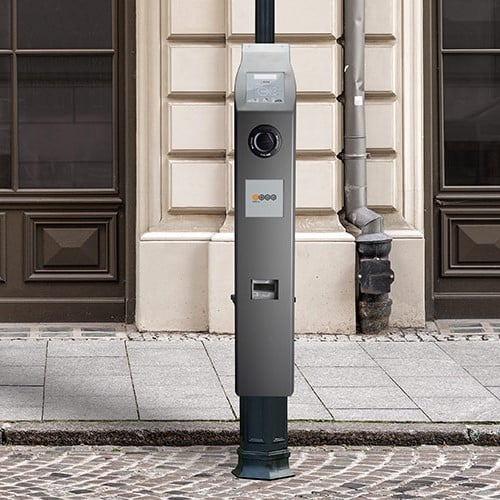
Charge her up, please: electromobility continues to be on the rise. The number of newly registered E-vehicles per year is steadily increasing. This trend applies both to fully electrical vehicles and to hybrid vehicles. Here, however, we already encounter the first problems – there is a shortage of public charging points. The solution? A streetlight.
In this article you will learn how charging at a streetlight works and what to consider.
##### Not enough charging stations
Whereas there is a steady increase in the number of electric cars, the number of publicly available charging points is growing only slowly. In big cities many owners of electric vehicles face the problem that there simply are too few charging options where they can park for longer while charging their vehicle. 40 % to 60 % of the motorists living in German cities do not have their own parking space, and for the battery to be fully charged it needs to be connected to the power grid for several hours.
##### Streetlight EV charging
There is, however, a real alternative that can solve this problem: charging at a streetlight.
The idea behind this is quite simple: streetlights emit light, they therefore carry current. Hence the publicly available electric infrastructure can be used for the charging of electric cars.
In big cities especially, where hardly anyone has their own parking space or garage, streetlight charging is a true alternative. This solution can serve to enormously expedite the expansion of the EV charging infrastructure. Also, since public lighting was switched to LED technology the available power output is much higher than currently needed. This excess output can be used to charge electric vehicles.
However, one thing needs to be considered: As streetlights have a low charging power, streetlight charging is not meant for fast charging. As a consequence, parking situations at work or overnight, which involve long parking times, make streetlight charging viable and hence a genuine innovation.
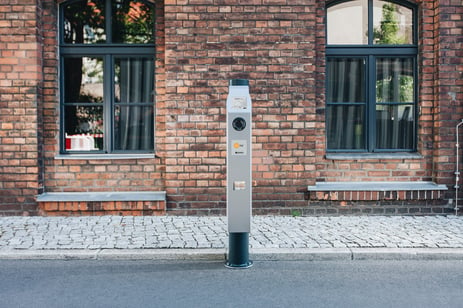
##### Further advantages of streetlight charging:
- utilization of an already available infrastructure
- cost-effective incorporation into existing power grids
- capability of being installed or de-installed at short notice
- low investment and operating cost
- with the streetlight connected to the low-voltage distribution network, a charging power of 11 kW can be realized in most cases
##### What is required:
- Parking space in the immediate vicinity of the streetlight
- Minimum lamp post diameter 115 mm
- Lamp post wall thickness approx. 5 mm
- The streetlight connection phase must be able to support an additional load of at least 10 A
##### Technical concerns overcome
Despite the obviously many advantages of streetlight charging, mayors and public utilities are reluctant when it comes introducing "lamppost charging" in their community. Concerns regard a supposedly excessively long charging time due to the low charging power available at the streetlights. Moreover, some see problems such as the inability to invoice the consumed energy separately or the insufficient cross section of the supply line for the lighting network. Often the question is raised how power is to be supplied during the day when the illumination is switched off.
These technical reservations are mostly unfounded. Since public illumination was changed to LED there is mostly enough electricity left in the lights. And the day-night-problem does not arise in the case of a distribution network, especially since here the lamps are connected separately to the main line and hence there is enough electricity available up to the cable transition point also during the day. In the case of an illumination network, i. e. when the lights are switched on for entire streets only at dusk, existing phases can be switched over to continuous current. These phases carry current also during the day, which is then available at the streetlight charging points. The switch operation, which can now be controlled separately for illumination and charging point, is effected via ripple control i.e. via an interface of the charging point's controller.
You can find more information and first application examples for lantern loading [here](https://de-blog.bender-group.com/en/lamppost_charging?hsLang=en).
[eMobility](https://de-blog.bender-group.com/en/topic/emobility?hsLang=en)
## This might also interest you

eMobility Electric Vehicles
##### [Insulation monitoring in the Formula Student design competition](https://de-blog.bender-group.com/en/formula_student?hsLang=en)
30. August 2023
Since its foundation in 1979, Formula Student has developed into one of the most renowned international design competitions for students. The aim of the competition is to provide...
Read more
eMobility Electric Vehicles
##### [Dynamic Load Management](https://de-blog.bender-group.com/en/dynamic_load_management?hsLang=en)
23. August 2023
In an increasingly electrified world, the expansion of the charging infrastructure in Germany for electric vehicles (EVs) is becoming more and more important. According to [statista](https://de.statista.com/statistik/daten/studie/244000/umfrage/neuzulassungen-von-elektroautos-in-deutschland/)
Read more
eMobility Electric Vehicles
##### [Energy transition galore](https://de-blog.bender-group.com/en/energy-transition-galore?hsLang=en)
15. December 2022
The world of mobility is changing. Soon, only vehicles with alternative drives will be rolling along our roads. In 2022, however, their share is still low: after all, more and...
Read more
-
-
-
-
-
-
[](https://www.co2neutralwebsite.de/certificate/6343/de)
© Bender GmbH & Co. KG